The global skills and competency framework for the digital world
SFIA - a skills framework for sustainable technology and GreenOps
Improving the environmental sustainability of technology requires skills and decisions across the organisation. Infrastructure and software teams can identify opportunities, but progress also depends on architecture, investment, procurement, service demand and leadership.
SFIA helps organisations describe the professional skills and levels of responsibility needed for this work. These resources connect sustainable technology and GreenOps needs to relevant SFIA skills, with guidance on assigning responsibilities and developing capability.
On this page
Background to using SFIA for sustainable technology and GreenOps
Find skills relevant to your organisational needs
Interactive, colour summary chart of sustainable technology and GreenOps skills in SFIA
12 x sustainable technology and GreenOps roles - explantion and details
Additional consultation for SFIA version 10
Introduction
Using SFIA for sustainable technology and GreenOps
This guide accompanies the SFIA Sustainable technology and GreenOps view.
It is intended for people working with sustainability, GreenOps, sustainable technology, the environmental aspects of ESG reporting, technology business management or related areas, including people who may not yet be familiar with SFIA.
The guide explains how the view works, where to start, how SFIA levels help assign responsibility and accountability, and how organisations can use SFIA for role design and capability development. It does not replace the published SFIA skill definitions or prescribe a particular operating model or set of job roles
SFIA provides a common language for describing professional capability. It can help organisations identify relevant skills, clarify the responsibility expected in roles and plan recruitment, learning and development.
Many relevant skills already exist in SFIA, including skills in strategy, governance, finance, architecture, software, operations, data and sourcing. The sustainability context adds particular knowledge, standards, measures and methods to these established areas of practice.
SFIA supports these decisions alongside specialist sustainability expertise and organisational governance. This collection focuses on the environmental sustainability of technology; it does not cover every aspect of environmental, social and governance practice.
New to SFIA?
SFIA describes professional skills at defined levels of responsibility. A role usually combines several skills, while the levels help describe the autonomy, influence, complexity and accountability involved.
Explore the sustainable technology and GreenOps reference page. Each entry starts with an organisational need and reveals relevant SFIA skills, an explanation of their contribution and routes to the published definitions.
The view supports both specialist sustainability or GreenOps roles and wider roles where sustainability-related responsibilities form part of existing professional practice.
Use this view to:
identify SFIA skills relevant to sustainable technology and GreenOps
support role design, workforce planning, learning and development
review where sustainability responsibilities sit across technology, finance, operations, data, procurement and governance
inform discussions about skill gaps, emerging practices and possible SFIA 10 updates.
Using the sustainable technology and GreenOps roles
Consider who produces evidence, who can authorise changes and who is accountable for outcomes. Explore the connections needed across technology, finance, procurement, facilities and business functions.
Review template roles and responsibilities that you can adapt to your organisation. The templates describe different contributions and responsibility levels, rather than prescribing job titles or an organisational structure.
SFIA 10 Consultation on Sustainable technology and GreenOps
Further gap analysis and investigations
The analysis work we have done to create this view - has identified a number of areas for further investigation. These will be fed into the usual SFIA 10 consultation and change request process.
All suggestions are welcome
Many thanks to Tim Prosser and Mark Butcher for expert analysis, advice and input to developing the contents of this SFIA view.
Sustainability SUST continues to recognise that sustainability capability is practised both through specialist sustainability roles and through sustainability responsibilities embedded in other professional roles.
Adding Level 3 gives clearer recognition to practitioners who apply established sustainability methods, assess impacts and make recommendations within defined areas.
The skill description, guidance and Levels 4–6 are adjusted to create a clearer progression from applying sustainability practice through to organisational leadership, while maintaining boundaries with other SFIA skills.
Organisations do not need to wait for SFIA 10 to use SFIA for sustainability and GreenOps roles and responsibilities.
SFIA profiles normally combine several professional skills with the relevant level of responsibility, knowledge and organisational context. Many sustainability-related activities at Level 3 are already described by existing SFIA 9 skills such as infrastructure operations, capacity management, measurement and data analytics.
The current Sustainability skill (SUST) can continue to be used at Levels 4–6 where the role includes distinct sustainability assessment, advice, methods or leadership.
Where sustainability is part of another professional responsibility, use the relevant SFIA skill at the appropriate level and add the sustainability knowledge, standards, measures and context required for the role.
SFIA and skills management
SFIA provides a common language throughout the skills management cycle
Evolution & track record
Field-tested approach over 20+ years: Used by practitioners, not a theoretical model
Established update process: Regular revisions with contributors, a global design authority, beta testing, structured releases and translations.
Global adoption: Across government, corporate, and education sectors in 12 languages
Expanding resources over time: Growing guidance materials and industry partnerships
Organic growth: Primarily spread through word-of-mouth success
Why choose SFIA?
Openness, collaboration, interoperability and availability to all employers and professionals worldwide sets the SFIA framework apart from similar frameworks in the industry.
Unlike many other frameworks, SFIA is open and accessible to all.
For most employers and all personal users, there are no fees or subscriptions required to access the content.
The framework is easy to access in many formats - web, pdf, xlsx, JSON, RDF
Updates to the framework are made transparently, we don't do "behind closed doors" updates
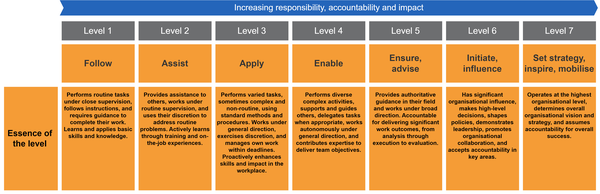
7 levels describing increasing responsibility, accountability and impact
SFIA's seven levels of responsibility provide a a structured framework for AI and ML skills, covering everything from foundational tasks to strategic leadership in intelligent systems.
This approach aligns job roles with real-world AI and ML demands, ensuring that practitioners at all levels possess the necessary expertise to build, operate, and enhance AI-driven technologies.
It supports the development of critical capabilities, from basic AI tool usage and data preparation to advanced model development, operational deployment, ethical considerations, and strategic decision-making.
SFIA enables focused professional growth, spanning the full spectrum of AI/ML skills—supporting career progression from hands-on data analysis and automation tasks to expert-level model optimisation, governance of intelligent systems, and leadership in AI strategy and innovation.
Click image to expand.
How SFIA works - Levels of responsibility and skills
Explore SFIA’s seven levels of responsibility, outlining the progression of responsibility, accountability and impact, and how professional skills and generic attributes define competence and support professional growth.
The value of SFIA's business skills and behavioural factors
Organisations need more than just technical expertise—they require well-rounded professionals with strong business skills and behavioural attributes. By combining these generic attributes with professional skills, SFIA provides a complete picture of what is expected from individuals at every level. The generic attributes also help organisations assess and plan for professional growth, making it easier to map career progression and align roles with business goals.
You can think of SFIA as an open-source project for professional skills.
We welcome contributions from the wider community to ensure our framework evolves with the needs of the industry. Because SFIA is not proprietary to specific vendors or industry bodies - anyone can provide feedback, suggestions, and contributions.